

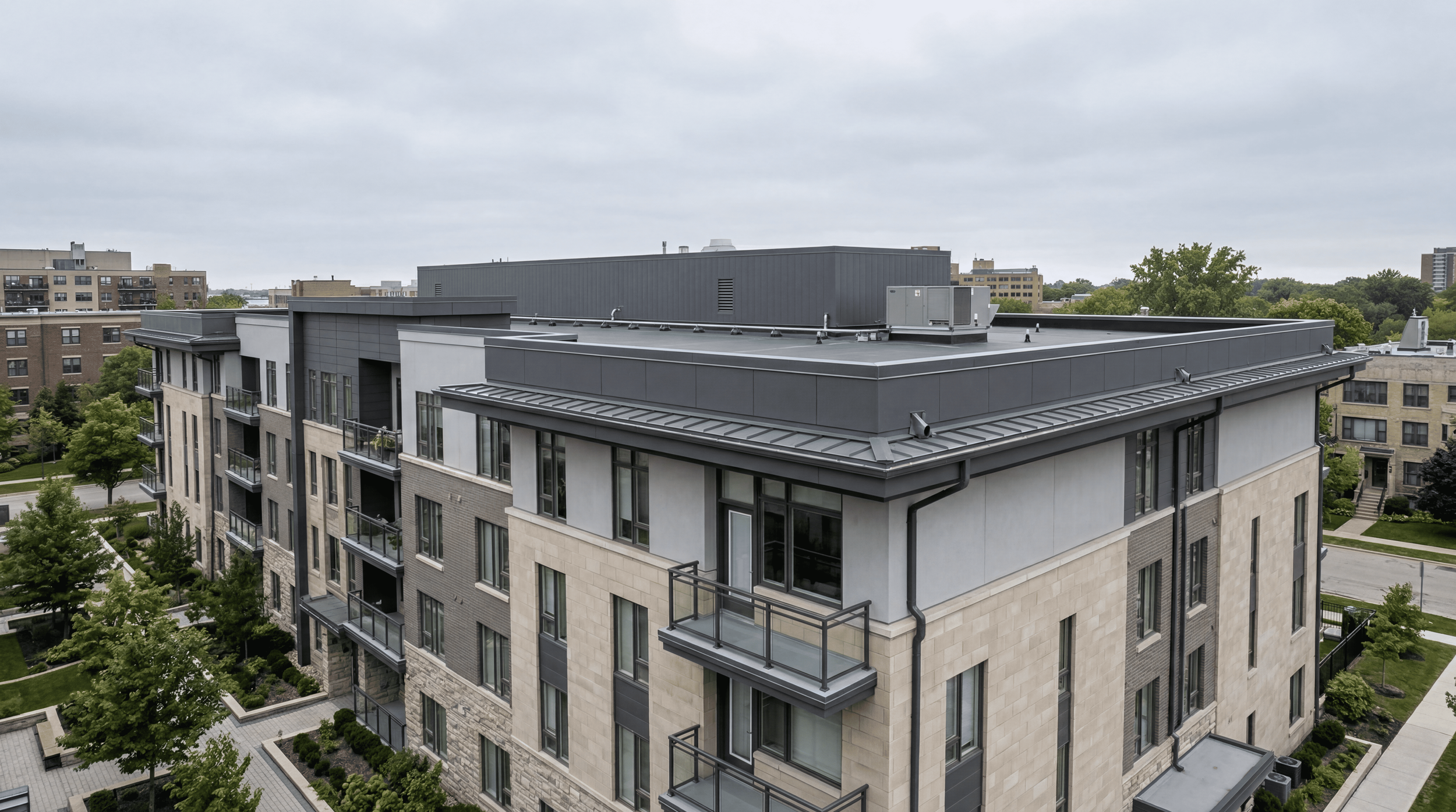
Commercial Roof Repair in Buffalo, NY
Clearline Building Envelope repairs commercial roofing systems across Buffalo and Western New York: leak repair, membrane repair, flashing and penetration repair, storm damage stabilization, and corrective work on TPO, EPDM, PVC, metal, and modified bitumen systems. Every repair comes with documented findings, a clear scope, and photos of the completed work. Call 716-817-8900.
Repair, done like a capital decision, not a patch job.
Most commercial roof repairs in Buffalo happen the same way: a tenant reports a leak, a contractor is called, something gets patched, and ownership never learns what actually happened up there.
Clearline works differently. Before we repair, we document the condition. After we repair, you receive a record of what was found, what was done, why it was the right scope, and what to watch next.
If a repair is only going to buy you a season, we say so. If the condition is systemic rather than isolated, you’ll know before you spend more money patching it.
That matters in Western New York more than most places. Freeze-thaw cycles, lake-effect snow loads, and wide temperature swings are hard on seams, flashings, and drainage. A roof that goes undocumented here doesn’t stay a small problem.
Commercial roof repairs we handle.
Roof Leak Repair
Locating the actual entry point, which is rarely where the drip shows up, then correcting the leak at its source.
Membrane Repair
TPO, EPDM, and PVC seam failures, punctures, shrinkage, and open laps, corrected before they spread.
Flashing and Penetration Repair
Curbs, pipes, HVAC units, parapets, and terminations, the details where most commercial roofs actually fail.
Metal Roof Repair
Fastener back-out, seam separation, rust-through, and panel damage on standing seam and screw-down metal systems.
Storm Damage Stabilization
Emergency dry-in, stabilization, and the photo documentation your insurance review will ask for.
Drainage Correction
Ponding water, clogged or undersized drains, and scupper issues, corrected before they shorten the roof’s life.
Why stakeholders engage Clearline for repair work.
Clearline approaches repair work as controlled risk management, not generic service dispatch.
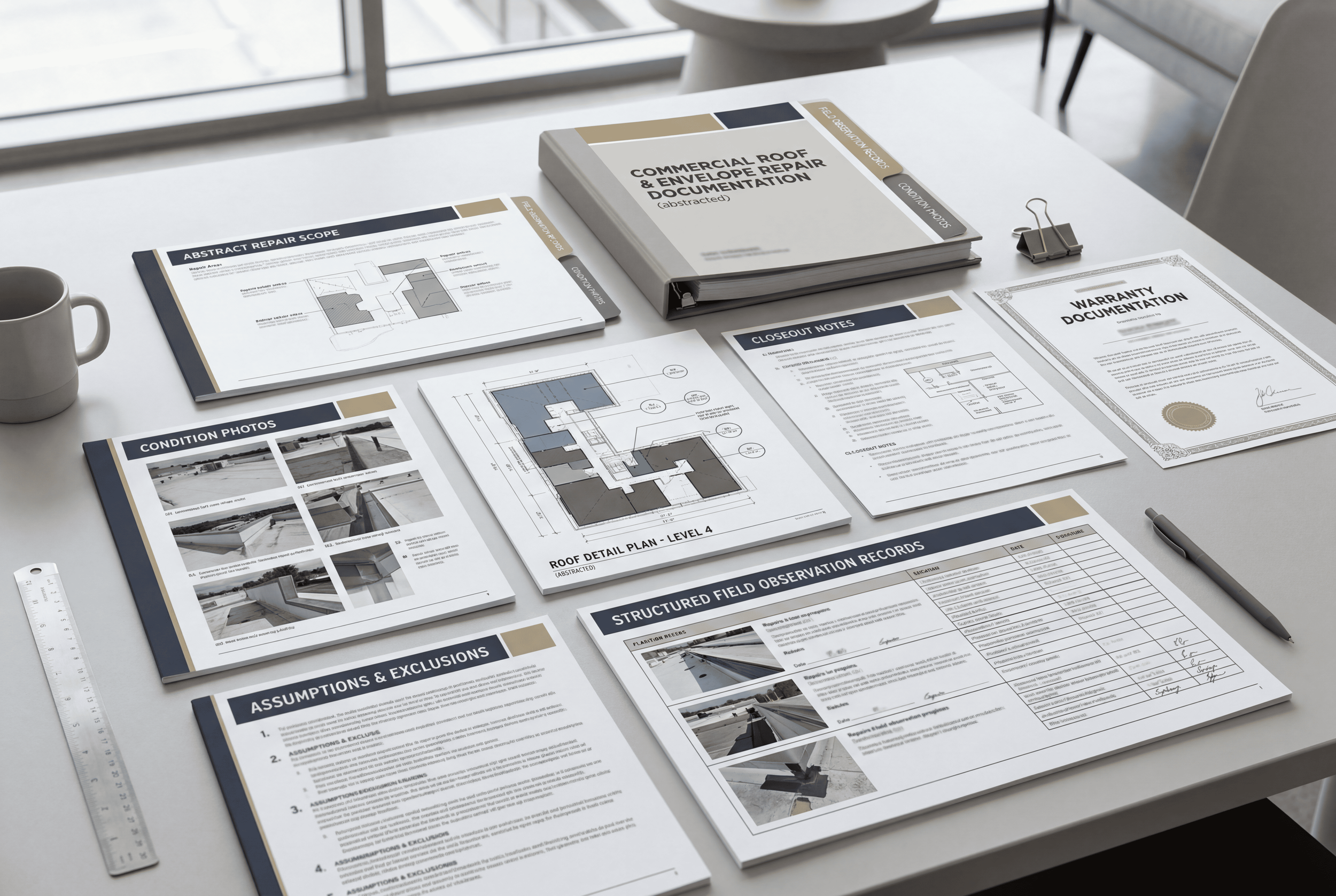
Repair engagements are scoped around identified conditions, assumptions, exclusions, and limitations. The goal is to avoid vague “fix everything” expectations that create confusion for ownership and uncontrolled exposure for the contractor.
The engagement also creates visibility beyond the immediate repair. Ownership should understand what the work resolves, what risks remain, what may require follow-up, and whether the condition should be monitored, investigated, budgeted, or escalated into a larger planning discussion.
Repair work is approached with attention to tenant impact, scheduling coordination, access constraints, operational continuity, budget timing, and documentation. Scope, observations, assumptions, and closeout information are documented in a structured manner so the record remains useful after the immediate work is complete.
Defined scope boundaries
Repair work is tied to identified conditions, documented assumptions, clear limitations, and realistic expectations.
Visibility beyond the repair
Ownership understands what the work resolves, what risk remains, and what may require monitoring, investigation, or future planning.
Operationally aware execution
Work is coordinated around tenant impact, access constraints, scheduling realities, safety considerations, and operational continuity.
Documentation discipline
Repair scope, assumptions, warranty terms, limitations, and closeout details are documented for future reference.
How repair engagements are structured.
Review property conditions and repair context
1.
Clearline reviews the property, current conditions, operational impact, urgency, prior repair history, known leak patterns, access requirements, ownership expectations, budget timing, and future capital planning considerations.
Define the appropriate repair pathway
2.
Where broader system uncertainty exists, Clearline may recommend diagnostic assessment or paid investigation before repair execution to determine whether the issue is isolated, recurring, systemic, concealed, or tied to broader lifecycle conditions.
Develop and execute the defined scope
3.
Clearline develops the repair scope, assumptions, exclusions, scheduling approach, pricing structure, documentation expectations, and warranty framework where applicable, then coordinates execution according to property conditions and operational requirements.
Repairs are not always permanent solutions.
Commercial roof and envelope systems often exist within broader lifecycle, deferred maintenance, drainage, access, or prior repair conditions.
In some situations, targeted repairs provide durable long-term correction. In others, repair work functions primarily as stabilization, temporary mitigation, operational protection, phased planning support, or a time-buying measure before replacement.
Clearline communicates those distinctions directly.
Ownership should understand what the repair is intended to accomplish, what risks remain, what conditions may continue evolving, and what future planning, investigation, or capital work should still occur.
That visibility matters as much as the repair itself.
Warranty structure
Warranty structure depends on the repair scope, existing system condition, accessibility, underlying deterioration, repair methodology, and broader roof lifecycle context.
Some repair scopes may support limited workmanship warranties. Others, especially stabilization-focused work on heavily deteriorated systems, may involve limited or no warranty structure because broader unresolved conditions remain.
Closeout documentation
Clearline documents the scope performed, assumptions, limitations, observed conditions, exclusions, warranty terms, and recommended follow-up where applicable.
The objective is to create realistic expectations, not generic warranty promises disconnected from actual system conditions.
Common questions.
-
Commercial roof repair pricing depends on the cause of the problem, the roof system, access and safety requirements, the extent of damage, and the corrective scope. Clearline reviews the condition and defines the work before providing pricing. Call 716-817-8900 or use the enquiry form to discuss your property.
-
Active leaks affecting tenants or operations get priority scheduling. Call 716-817-8900. Stabilization comes first; permanent scope follows documentation.
-
If the membrane is broadly sound and failures are localized, repair usually wins. If moisture is in the insulation across large areas, or failures keep recurring across the field of the roof, repair money is usually better spent planning restoration or replacement. This is exactly the decision our Targeted Roof & Envelope Decision Assessment answers.
-
Yes. Most of our work is on occupied commercial, industrial, multifamily, and senior housing properties. Scopes are planned around operations.
-
Buffalo and all of Erie County, plus Niagara, Genesee, Monroe, Wayne, Ontario, Orleans, Wyoming, Livingston, Allegany, Cattaraugus, and Chautauqua counties.
If your building has an active leak, start with clarity.
If your building has an active leak or a repair you’ve been deferring, call 716-817-8900 or start a conversation online.
You’ll get documented findings and a defensible scope, not a sales inspection.
If you are deciding whether to repair now or plan larger work, explore our roof and envelope assessment. For work beyond a targeted repair, see our roof replacement and envelope restoration services. Our roof and envelope stewardship pathway supports ongoing condition review.
Get your repair scoped.
Tell us what your roof is doing and where the building is. You’ll hear back with next steps, not a sales pitch. Active leak? Call 716-817-8900 now.
Contact Details
Phone: 716-817-8900
Email: info@clearlineenvelope.com