

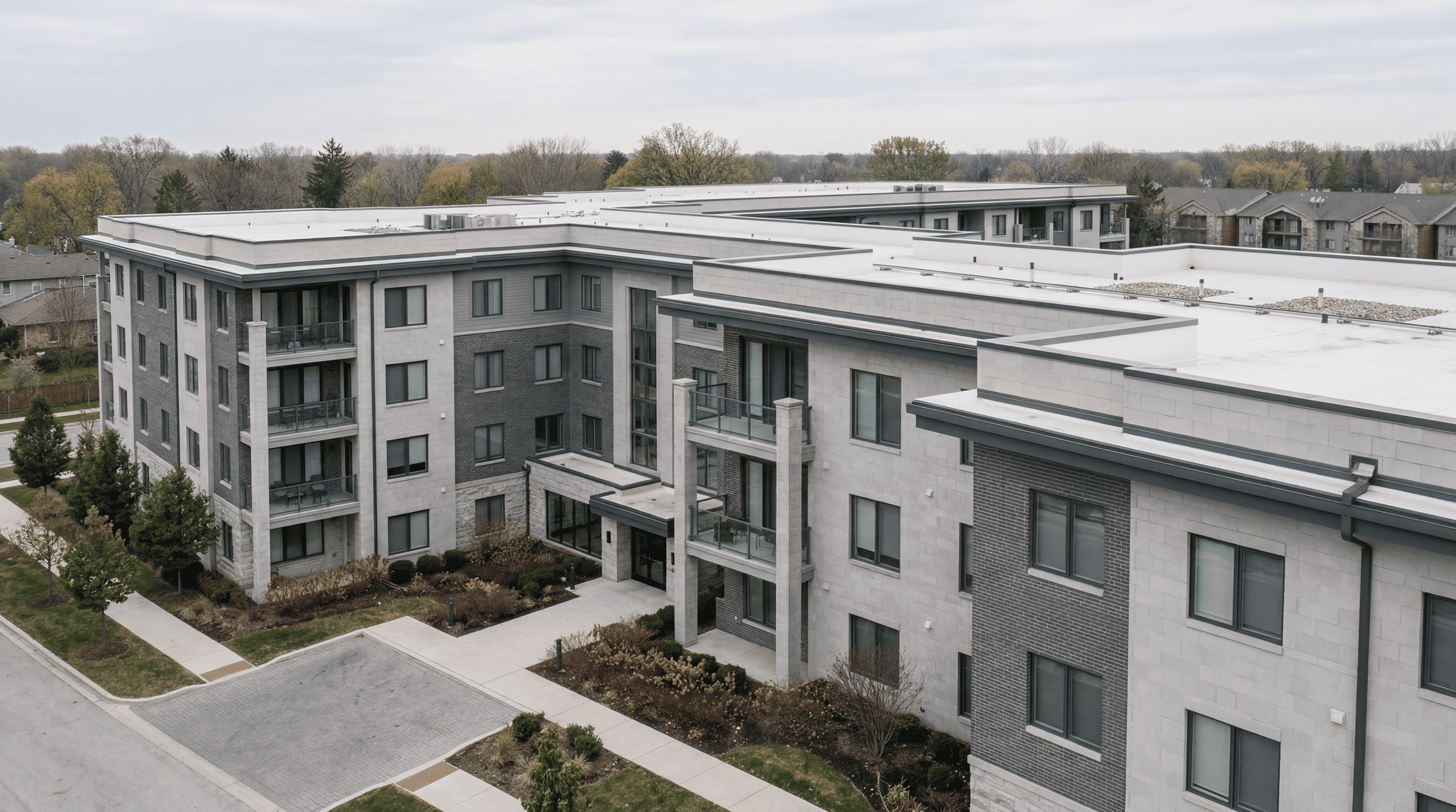
Clarity before repair, replacement, or further investigation.
A Targeted Roof and Envelope Decision Assessment helps commercial property stakeholders understand roof and exterior envelope conditions before committing to major repair, replacement, capital planning, or recurring repair decisions.
A focused decision assessment built around a specific property concern.
A TREDA is a structured single-property engagement designed to help ownership understand what conditions exist, how urgent they are, whether the issue is isolated or systemic, and what next-step pathway makes the most sense.
The engagement exists because many commercial roof and envelope decisions are made with incomplete visibility. Ownership may be weighing recurring leaks, conflicting contractor recommendations, unclear replacement timing, emergency spending pressure, budget-cycle constraints, incomplete documentation, or uncertainty around whether to repair, investigate, defer, or plan for replacement.
A TREDA is designed to reduce that uncertainty before ownership commits to repair, investigation, replacement planning, or continued deferral.
The objective is not simply to inspect a roof. The objective is to help ownership determine whether repair, stabilization, paid investigation, restoration, monitoring, replacement planning, or another defined pathway is appropriate.
Common situations that trigger a TREDA.
Recurring leaks
A TREDA helps clarify whether recurring leaks appear isolated, systemic, repairable, or tied to broader roof and envelope performance risk.
Repair vs. Replacement
A TREDA helps ownership evaluate whether targeted corrective work is reasonable or whether replacement planning should begin.
Conflicting Recommendations
A TREDA provides an organized decision reference when contractors are recommending different scopes, costs, or levels of urgency.
Reserve Planning
A TREDA supports budgeting by clarifying current conditions, near-term risks, likely future capital needs, and timing considerations.
Ownership Approval
A TREDA gives property teams clear documentation to support capital requests, scope decisions, budget discussions, and ownership-level review.
Aging Roof Systems
A TREDA helps evaluate service-life concerns, timing pressure, and whether phased planning should begin before conditions accelerate.
Decision-ready documentation.
The TREDA deliverable helps ownership move from fragmented information to a clearer decision pathway.
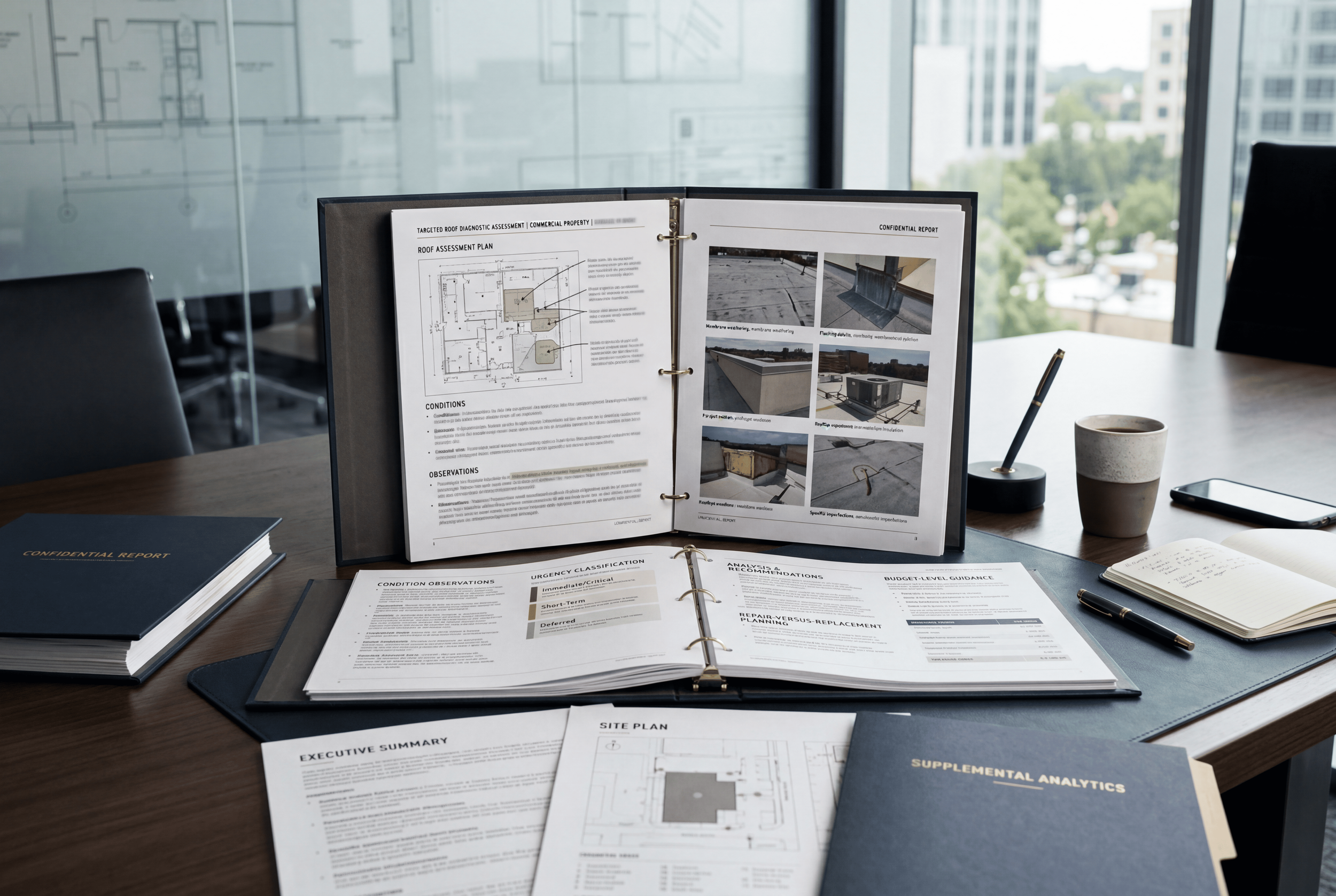
Depending on the property and engagement context, the report may include condition observations, photo documentation, identified deficiencies, urgency classification, repair-versus-replacement analysis, sequencing recommendations, budget-level cost guidance, operational impact considerations, lifecycle observations, maintenance considerations, and recommended next steps.
The report is structured for practical use by owners, asset managers, property managers, lenders, insurers, capital partners, contractors, and internal approval teams.
The objective is not simply to document defects. It is to help ownership understand what the conditions mean operationally, financially, and practically.
Why stakeholders engage Clearline for decision assessment work.
Clearline’s assessment work is structured around decision clarity before major scope assumptions are made.
The engagement exists independently from future execution decisions. Ownership retains flexibility around next steps, including repair, restoration, replacement planning, stewardship, competitive bidding, paid investigation, or no immediate action.
When corrective work is warranted, the assessment can be converted into a defined repair, stabilization, restoration, replacement, or capital project pathway with clear scope assumptions and execution boundaries.
The assessment connects roof and envelope conditions to timing, reserve exposure, operational disruption, budget planning, and broader capital considerations.
Reports are built for the people responsible for approving, budgeting, financing, managing, or executing the work. They are intended to support decisions, not simply document observations.
Structured diagnostic process
Conditions are identified and organized before major scope assumptions are made.
Flexible next-step support
The assessment does not require future execution with Clearline, but findings can be converted into repair, planning, investigation, or project pathways when appropriate.
Capital-oriented visibility
Findings are connected to timing, reserve exposure, operational disruption, budget planning, and broader capital considerations.
Documentation ownership can use
Reports are structured for the stakeholders responsible for approving, budgeting, financing, or managing the work.
How the engagement works.
Initial review
1.
Engagement alignment
2.
Field review and reporting
3.
TREDA engagements typically begin with a brief discussion about the property, known conditions, urgency, operational concerns, ownership context, planning pressures, budget timing, transaction or insurance involvement, and timeline considerations.
Following alignment on scope and objectives, Clearline defines the engagement structure, deliverables, timeline, fee, assumptions, exclusions, and next steps.
Field review and reporting then proceed within the defined engagement timeline.
This structure protects both parties by clarifying what is being reviewed, what the deliverable will provide, and how the information will support the decision being made.
Typical engagement range.
Most TREDA engagements range from $1,200 to $3,500, depending on property size, roof complexity, urgency, accessibility, documentation requirements, transaction timing, and reporting complexity.
Typical delivery is 2 to 4 weeks. Expedited scheduling may be available where appropriate.
Advanced investigation, moisture testing, core sampling, thermal review, destructive investigation, forensic review, or litigation-related documentation is not included unless specifically defined in the engagement scope.
Final fee and timeline are determined during engagement alignment based on the property, the decision context, and the level of documentation required.
Targeted Roof and Envelope Decision Assessment
Typical Range: $1,200 to $3,500
Delivery: 2 to 4 weeks
Expedited delivery available upon request
Common questions.
-
No. A TREDA is a decision assessment designed to create visibility before execution decisions are made. If corrective work is warranted, Clearline can develop repair, stabilization, restoration, stewardship, investigation, or capital project pathways separately.
-
No. The engagement may include broader exterior envelope observations where those conditions materially affect the assessment context.
-
Yes. The deliverable is structured to support broader commercial property decision-making conversations.
-
Urgent conditions are identified within the report and discussed with the stakeholdnvestigation, or escalation pathways can be evaluated appropriately.
-
Yes. Many engagements are initiated specifically to support budgeting cycles, reserve planning discussions, or ownership-level capital review.
-
If visual review cannot reasonably clarify the condition, Clearline may recommend a paid investigation before repair, replacement, or capital decisions are finalized.
Better visibility before major scope decisions.
Commercial roof and envelope conditions become expensive when ownership is forced into reactive decisions without clear documentation, realistic prioritization, defined scope, or practical action pathways.
A TREDA is designed to help ownership determine the right next step before repair cycles, unclear scope, or deferred conditions become larger capital problems.