

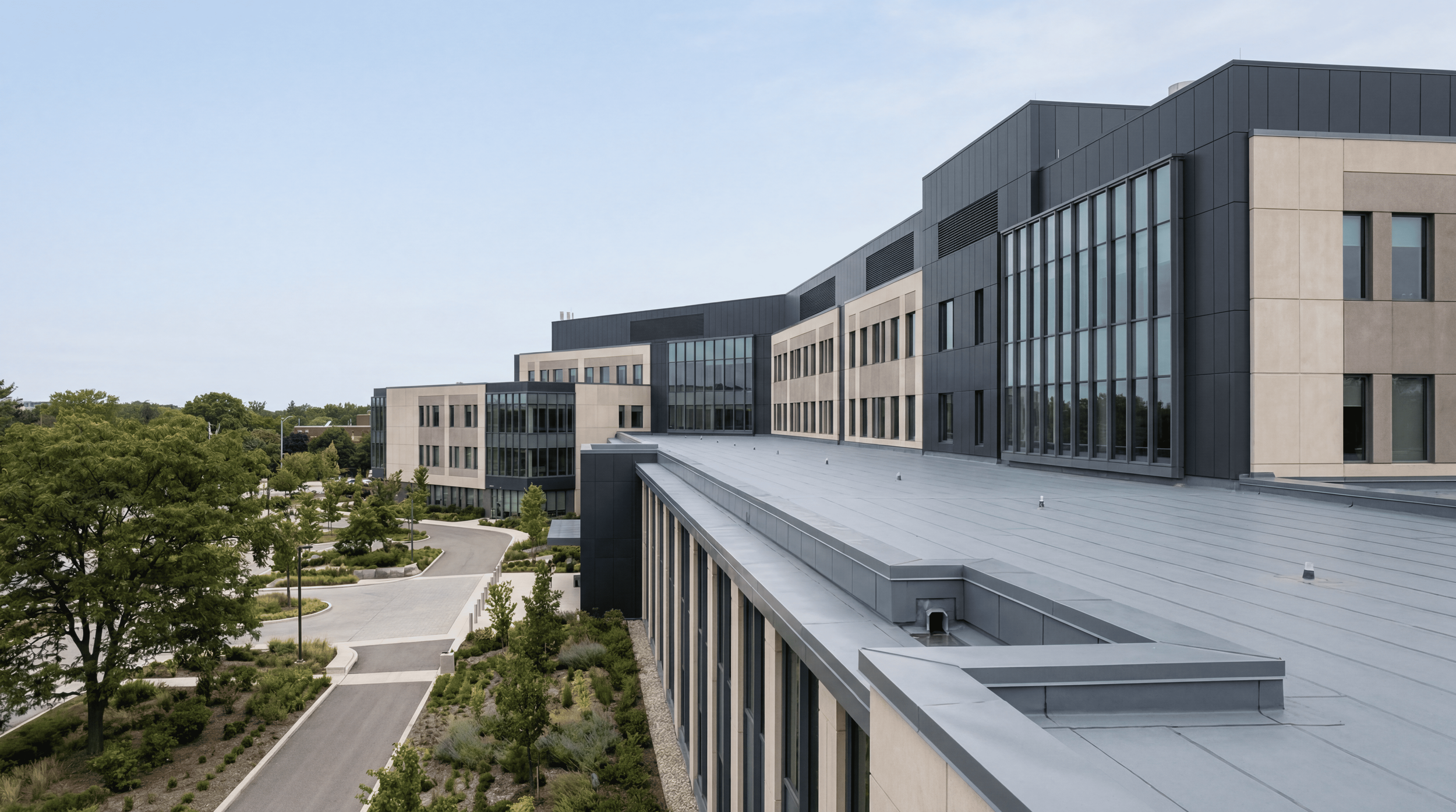
Controlled execution for major roof and envelope capital work.
Clearline provides structured roof replacement, envelope restoration, and capital project execution for commercial properties where ownership requires defined scope, operational coordination, disciplined documentation, and controlled project delivery.
Roof and envelope capital execution built around scope clarity and operational control.
Capital Projects involve full-scope roof replacement, exterior envelope restoration, phased capital execution, or coordinated multi-property roof and envelope work.
These engagements typically occur when ownership is navigating aging roof systems, replacement timing pressure, recurring repair escalation, deferred maintenance accumulation, operational disruption risk, insurance-related reconstruction, portfolio capital sequencing, or major building lifecycle transitions.
Clearline approaches capital execution through a structured process intended to reduce scope ambiguity, operational disruption, change-order instability, undocumented assumptions, contractor-driven scope inflation, and reactive decision-making during construction.
The objective is not simply completing a replacement project.
The objective is delivering controlled execution tied to documented conditions, defined scope pathways, budget timing, and ownership priorities.
Choosing restoration or replacement
Restoration can be considered when documented conditions support extending service life without full replacement. Replacement becomes the clearer path when deterioration is widespread, repeated repairs no longer control risk, or the existing system cannot support the required scope. Clearline reviews roof and envelope conditions, operational needs, and long-term ownership priorities before defining the project pathway.
What affects project cost
Capital-project pricing depends on the roof or envelope system, affected area, access and safety requirements, tear-off and disposal needs, drainage and edge details, occupied-building coordination, phasing, seasonal timing, and the final corrective scope. Clearline documents conditions and defines assumptions, exclusions, sequencing, and responsibilities before pricing is finalized.
Common situations that trigger Capital Projects.
Lifecycle Deterioration
Capital Projects are appropriate when roof or envelope systems have reached later-stage deterioration and continued repairs no longer provide meaningful long-term value.
Broader Envelope Scope
Capital Projects support conditions that extend beyond isolated repairs and require larger corrective scope across the roof, exterior envelope, drainage, edge metal, or related assemblies.
Phased Replacement Planning
Capital Projects help ownership structure replacement work around budgeting cycles, portfolio sequencing, tenant coordination, seasonal constraints, or operational requirements.
Competing Capital Needs
Capital Projects provide a clearer basis for prioritizing roof and envelope investment against other property or portfolio-level capital demands.
Insurance-Related Reconstruction
Capital Projects may support storm, loss, or recovery-related restoration where approved scope, documentation, sequencing, and coordination must be carefully managed.
Operationally Sensitive Properties
Capital Projects are structured for tenant-occupied, healthcare, multifamily, industrial, logistics, senior living, or commercial environments where execution must protect continuity.

Why stakeholders engage Clearline for capital execution.
Clearline manages capital execution as part of a broader ownership and operational decision environment.
Projects are reviewed and scoped before execution begins to reduce ambiguity, uncontrolled changes, and reactive decision-making during construction. Execution is coordinated around tenant impact, scheduling constraints, property operations, access limitations, seasonal conditions, and continuity requirements.
Project documentation, assumptions, scope boundaries, warranty structure, and closeout records are treated as critical components of the engagement itself.
The goal is not only to complete the installation. The goal is to help ownership understand what work is being performed, why it is being performed, what decisions were made, what responsibilities remain, and how the asset should be managed after completion.
Scope discipline before construction
Projects are reviewed and scoped before execution begins to reduce ambiguity, unsupported assumptions, uncontrolled changes, and reactive field decisions.
Operationally aware project planning
Execution is coordinated around tenant impact, access limitations, seasonal timing, scheduling constraints, safety considerations, and property operations.
Documentation-driven execution
Project assumptions, scope boundaries, progress documentation, change documentation, and closeout records are treated as part of the work.
Visibility beyond installation
Ownership receives clearer information around maintenance expectations, warranty considerations, remaining responsibilities, and long-term lifecycle implications.
How capital engagements are developed.
Review property conditions and repair context
1.
Clearline reviews property conditions, roof and envelope history, operational requirements, ownership priorities, budget timing, accessibility constraints, existing documentation, prior repair history, insurance or recovery considerations, and tenant or operational sensitivities.
Clarify scope before capital is committed
2.
Where condition uncertainty exists, Clearline may recommend diagnostic review, paid investigation, or planning work before final project development to improve scope visibility and reduce execution uncertainty.
Develop and execute the defined project pathway
3.
Clearline develops the project scope, sequencing considerations, assumptions, exclusions, pricing structure, scheduling framework, coordination requirements, documentation expectations, and warranty structure where applicable, then proceeds according to the defined project pathway and operational coordination plan.
Major roof work is an operational event, not just a construction event.
Commercial roof and envelope replacement projects affect more than the roof system itself.
They may affect tenants, residents, logistics operations, ownership reporting, insurance coordination, budgeting cycles, financing requirements, maintenance planning, and operational continuity.
Clearline approaches capital execution with emphasis on planning discipline, communication clarity, scope control, sequencing awareness, documentation consistency, and operational coordination.
The objective is reducing unnecessary disruption while maintaining clear visibility into what is being executed, why it is being executed, and what ownership should expect after completion.
Structured closeout
Warranty structure depends on the system type, project scope, manufacturer requirements, maintenance obligations, existing conditions, and execution pathway.
Where applicable, projects may include workmanship warranty structure, manufacturer warranty coordination, repair limitations, maintenance obligations, and closeout documentation.
Long-term visibility
Closeout may include maintenance requirements, photographic records, project completion documentation, warranty information, remaining condition notes, and ongoing stewardship recommendations.
The objective is not simply turning over a completed roof. The objective is helping ownership maintain long-term visibility into the asset after execution is complete.
Common questions.
-
Not necessarily. Some projects proceed directly through structured project review and scope development. Where condition uncertainty exists, diagnostic review, paid investigation, or planning engagement may be recommended before final project execution pathways are established.
-
Existing specifications, reports, or contractor proposals may inform review, but Clearline independently evaluates project conditions, scope assumptions, execution requirements, and risk factors before finalizing scope.
-
Yes. Many capital engagements are structured around phased execution tied to budgeting cycles, operational constraints, tenant coordination, seasonal timing, insurance requirements, or portfolio planning.
-
Yes, where appropriate. Execution partners operate under structured scope, documentation, insurance, safety, and coordination requirements intended to support project consistency and accountability.
-
Frequently. TREDA, CPE, APR, RES, and Service and Repair engagements may lead into phased repair, stewardship, paid investigation, or full capital execution pathways.
Capital execution should reduce uncertainty, not create more of it.
Commercial roof and envelope projects become difficult when ownership lacks clear scope, realistic planning, operational coordination, budget awareness, documentation discipline, or execution control.
Clearline approaches capital work with emphasis on visibility, structure, communication, and controlled execution aligned with broader ownership priorities.