

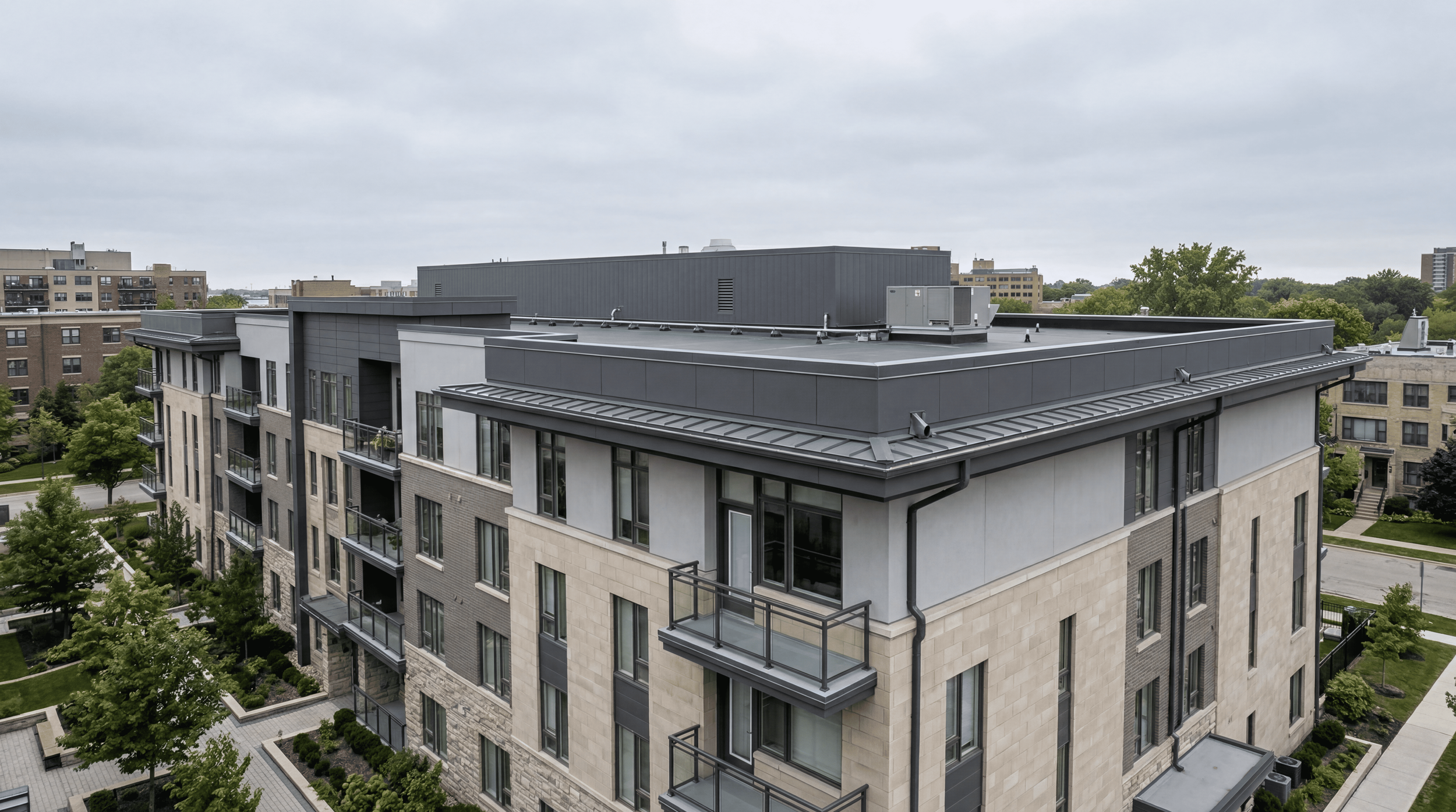
Commercial Roof Replacement in Buffalo, NY
Replacing a commercial roof is a capital project, and it should be run like one. Clearline Building Envelope plans and executes commercial roof replacement across Buffalo and Western New York: TPO, EPDM, PVC, and metal systems, with defined scope, documented existing conditions, clear pricing structure, and closeout documentation ownership can actually use. Call 716-817-8900.
Why replacement projects go wrong, and how we run them.
Ask any Buffalo property manager who has been through a bad reroof: the problem is rarely the membrane. It’s an undefined scope, surprise change orders, no documentation of what was found under the old roof, and a closeout package that amounts to a handshake.
Clearline runs replacement as a controlled capital project. Conditions are documented before pricing, the scope and system are defined on evidence, execution is scheduled around your operations, and closeout leaves you with warranties, photos, and as-built details.
Tear-off versus recover gets decided on evidence, not on what a crew happens to install. The right system for the building and Western New York’s climate, priced on knowns instead of unknowns.
Planning a commercial roof replacement.
Existing Roof Conditions
Document the existing roof condition, recurring problems, and operational priorities before defining replacement scope.
Roof System Selection
Consider TPO, EPDM, PVC, or metal systems in the context of the building, existing conditions, and project requirements.
Project Details
Include curbs, pipes, HVAC units, parapets, and terminations in the defined scope so critical details are addressed.
Tear-Off or Recover
Evaluate existing conditions before deciding whether removal or a recover approach is appropriate for the building.
Occupied-Building Coordination
Plan access, scheduling, and execution around tenants, ongoing operations, and site constraints.
Closeout and Future Planning
Keep scope, project observations, applicable warranty terms, and closeout documentation available for future property decisions.
Why stakeholders engage Clearline for replacement work.
Clearline approaches replacement as a capital project with defined scope, documented conditions, and coordinated execution. The project starts with the existing roof and the decision ownership needs to make. Scope, assumptions, exclusions, and limitations should be clear before work begins. Planning considers operational impact, access, scheduling, and budget timing. Findings and project documentation help ownership understand the work and its implications for the property.
Defined scope boundaries
Replacement work is tied to identified conditions, documented assumptions, clear limitations, and realistic expectations.
Visibility beyond installation
Ownership understands what the work resolves, what risk remains, and what may require monitoring, investigation, or future planning.
Operationally aware execution
Work is coordinated around tenant impact, access constraints, scheduling realities, safety considerations, and operational continuity.
Documentation discipline
Project scope, assumptions, warranty terms, limitations, and closeout details are documented for future reference.
How replacement projects are structured.
Review property conditions and capital priorities
1.
Clearline reviews the property, current conditions, operational impact, urgency, prior repair history, known leak patterns, access requirements, ownership expectations, budget timing, and future capital planning considerations.
Define the appropriate replacement pathway
2.
Where broader system uncertainty exists, Clearline may recommend diagnostic assessment or further investigation before replacement planning to understand the condition and appropriate scope.
Develop and execute the defined scope
3.
Clearline develops the project scope, assumptions, exclusions, scheduling approach, pricing structure, documentation expectations, and warranty framework where applicable, then coordinates execution according to property conditions and operational requirements.
Replacement should follow a clear decision.
An aging or leaking roof does not automatically establish the right replacement scope. Existing conditions, previous repairs, operational requirements, and capital priorities need to be understood first. Where conditions remain uncertain, diagnostic assessment or further investigation can inform whether targeted work, restoration, or replacement should be considered. Explore our roof and envelope assessment for help with planning. Clearline capital projects support defined scope and execution.
Warranty structure
Applicable warranty terms depend on the selected system, project scope, and documented agreement. Clearline defines the warranty framework with the project rather than making a blanket promise before conditions and scope are understood.
Closeout documentation
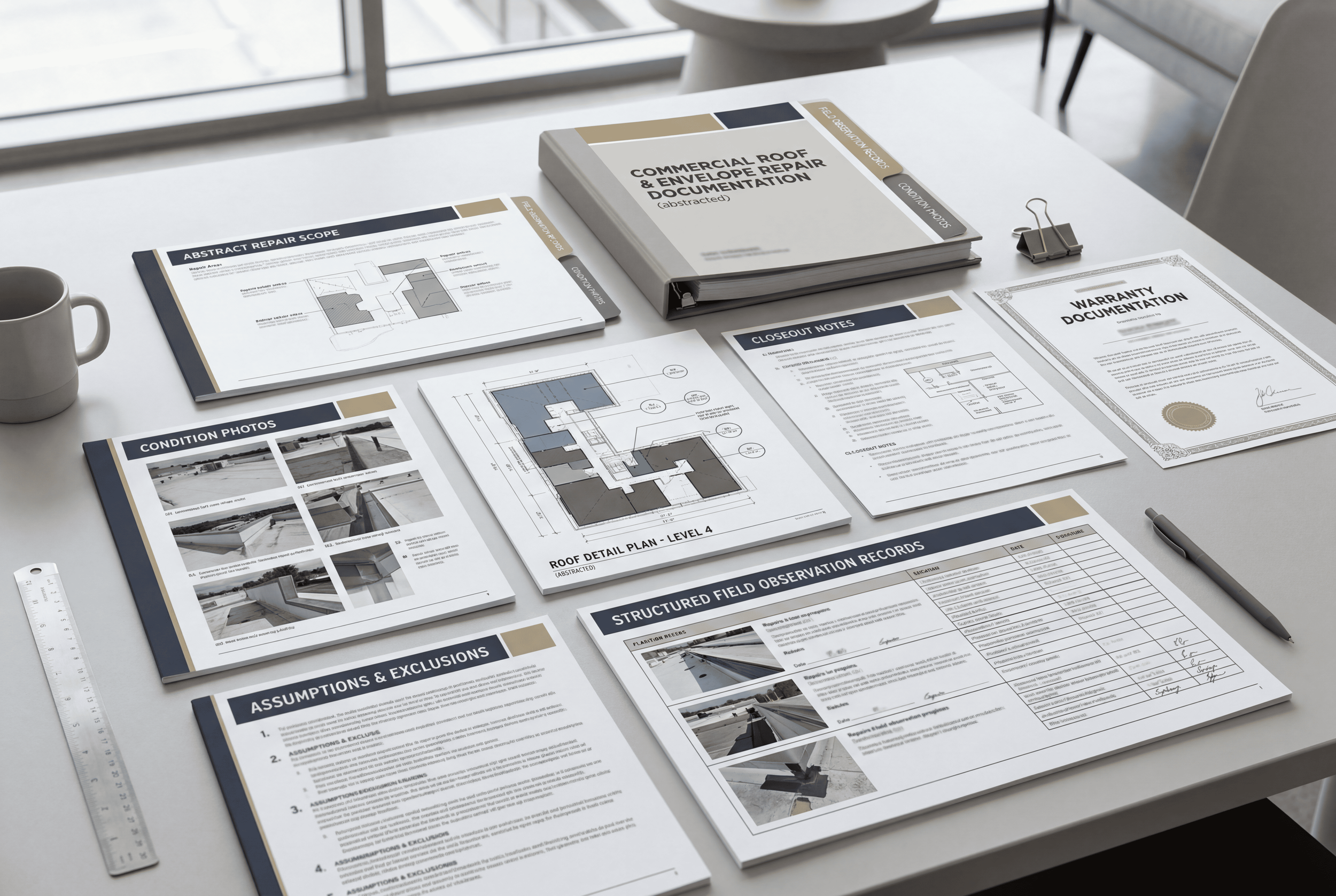
Clearline documents the scope performed, assumptions, limitations, observed conditions, exclusions, warranty terms, and recommended follow-up where applicable.
The objective is to create realistic expectations, not generic warranty promises disconnected from actual system conditions.
Common questions.
-
Replacement cost depends on roof size, existing conditions, removal or recover requirements, the selected system, access, and project details. Clearline defines scope, assumptions, exclusions, and pricing for the specific building after reviewing the conditions. Contact us to discuss the property and the next step toward a documented scope.
-
Scheduling depends on the documented scope, roof system, site access, and the needs of the occupied building. Clearline coordinates planning and execution around property conditions and operational requirements. Discuss timing during scope development so assumptions and limitations are clear before work begins.
-
If the membrane is broadly sound and failures are localized, repair usually wins. If moisture is in the insulation across large areas, or failures keep recurring across the field of the roof, repair money is usually better spent planning restoration or replacement. This is exactly the decision our Targeted Roof & Envelope Decision Assessment answers.
-
Yes. Most of our work is on occupied commercial, industrial, multifamily, and senior housing properties. Scopes are planned around operations.
-
Buffalo and all of Erie County, plus Niagara, Genesee, Monroe, Wayne, Ontario, Orleans, Wyoming, Livingston, Allegany, Cattaraugus, and Chautauqua counties.
Planning a roof replacement? Start with clarity.
If you are evaluating replacement for a commercial building, call 716-817-8900 or start a conversation online. Discuss existing conditions, operational needs, and the next step toward a defined project scope.
Discuss your replacement project.
Tell us about your commercial building, the roof condition, and your planning priorities. Call 716-817-8900 or use the enquiry form below to discuss the next step.
Contact Details
Phone: 716-817-8900
Email: info@clearlineenvelope.com