

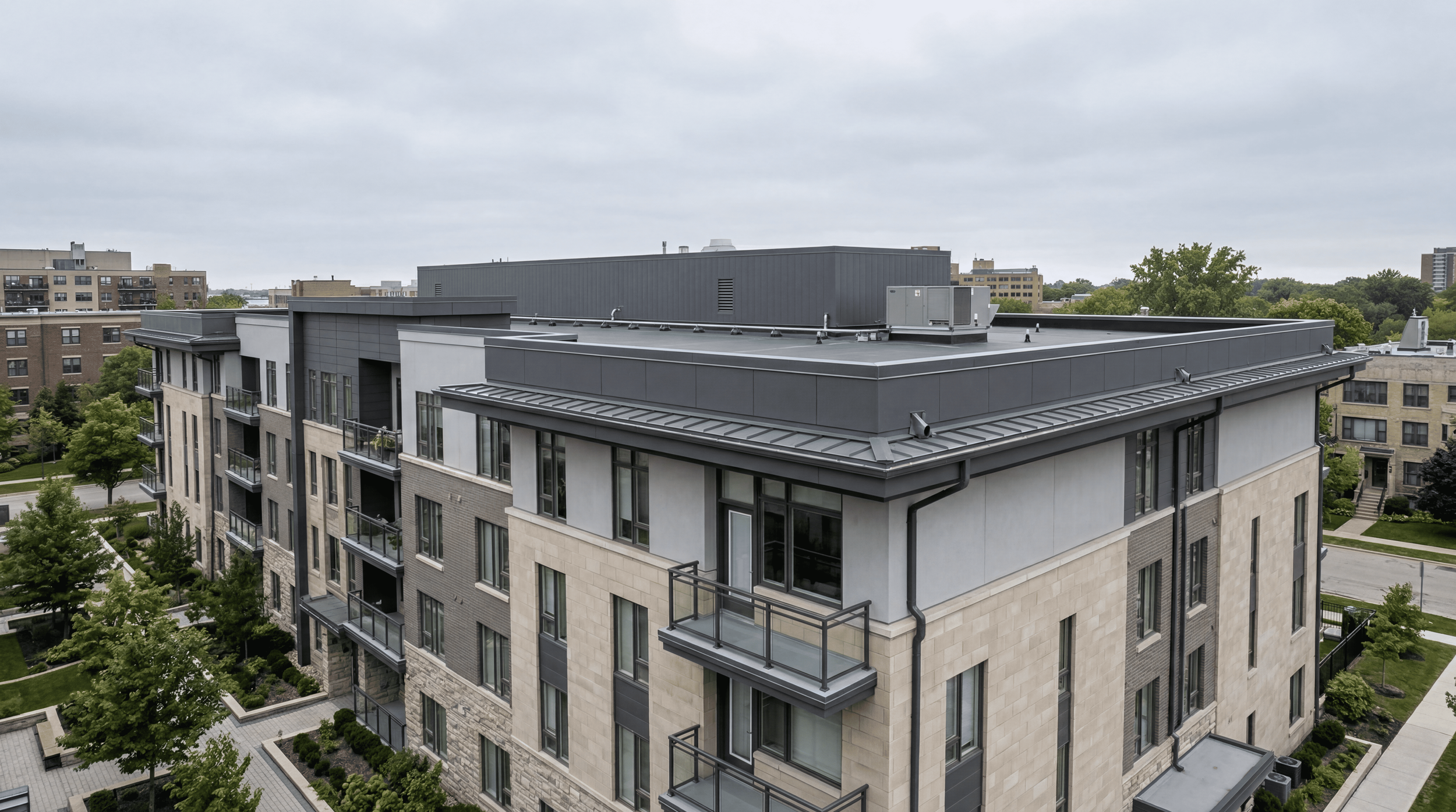
Targeted corrective work with defined scope and clearer visibility.
Clearline provides structured roof and exterior envelope repair, stabilization, and corrective execution for commercial properties where ownership needs operational response without losing visibility into broader condition risk, future planning, or capital implications.
Controlled corrective execution for commercial roof and envelope conditions.
Service and Repair engagements address identified roof and exterior envelope conditions through targeted corrective work, stabilization measures, or limited repair scope.
These engagements are typically appropriate when ownership is dealing with active leaks, localized failures, recurring problem areas, tenant disruption, storm-related conditions, phased capital planning, or aging systems where full replacement may not be the right immediate move.
Clearline approaches repair work with a simple principle: a repair should have a clearly defined purpose.
That purpose may be stopping active water intrusion, stabilizing a deteriorating condition, extending operational time, reducing immediate risk, supporting budget timing, buying time before replacement, or addressing an isolated failure.
The objective is not simply patching the roof. The objective is understanding what the repair is intended to accomplish, what limitations remain, and what ownership should monitor, investigate, budget, or plan next.
Managing a building in Western New York? Read about our commercial roof repair services in Buffalo, including leaks, membrane damage, flashing issues, and drainage problems.
Common situations that trigger Service and Repair engagements.
Active Water Intrusion
Service and Repair helps address active leaks affecting tenants, interiors, operations, ownership confidence, or short-term property performance.
Localized Deterioration
Service and Repair supports targeted corrective work when specific roof or envelope areas have deteriorated but the broader system may remain serviceable.
Stabilization Needs
Service and Repair provides controlled short-term action before future restoration, replacement, insurance review, paid investigation, or capital planning occurs.
Recurring Repair Conditions
Service and Repair helps clarify whether repeated service issues are isolated repair needs or signs of unresolved system conditions.
Storm-Related Conditions
Service and Repair can address roof or envelope conditions following weather events where targeted response, documentation, or further review may be needed.
Operationally Sensitive Properties
Service and Repair supports properties where work must be coordinated around tenants, healthcare environments, logistics operations, resident safety, or business continuity.
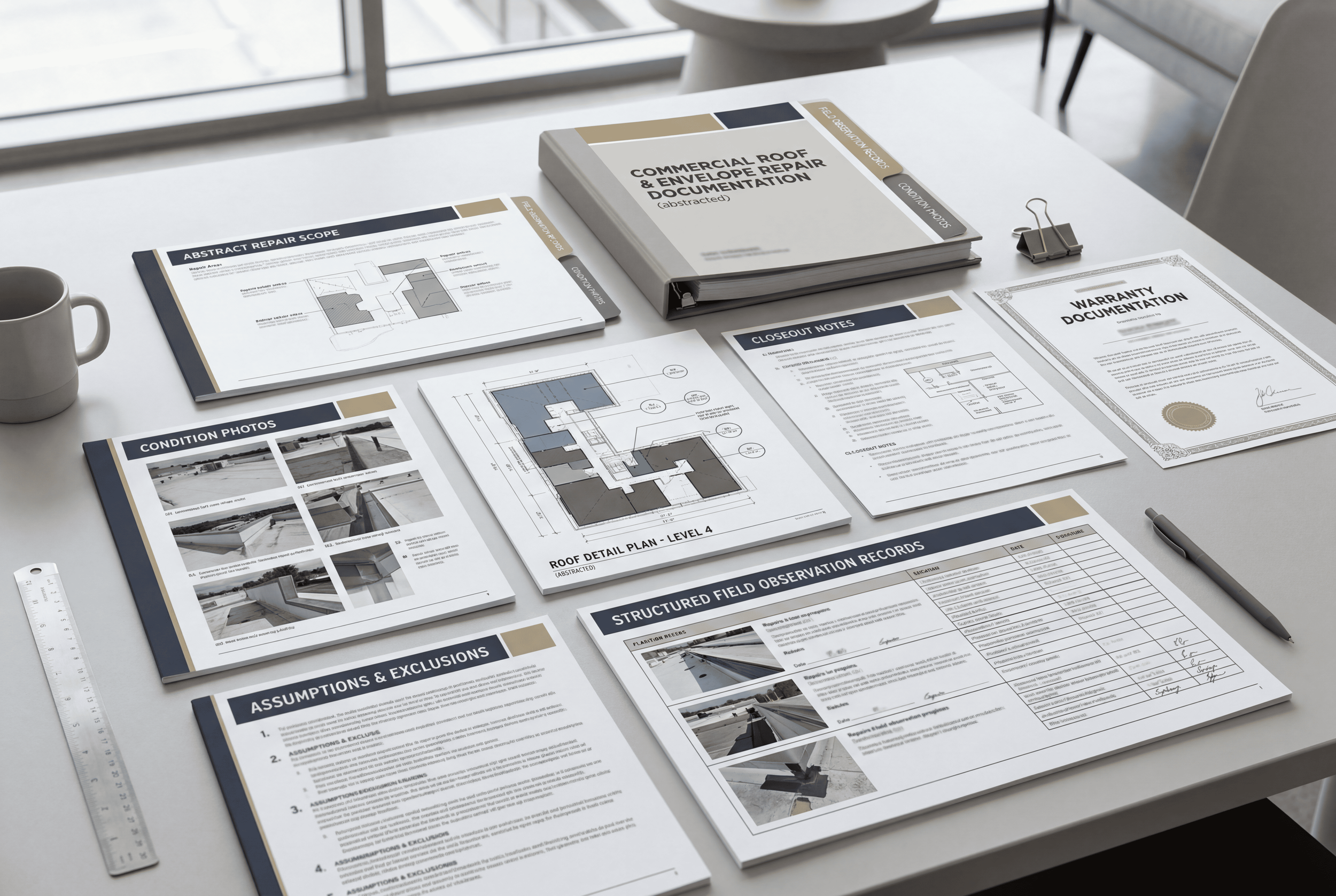
Why stakeholders engage Clearline for repair work.
Clearline approaches repair work as controlled risk management, not generic service dispatch.
Repair engagements are scoped around identified conditions, assumptions, exclusions, and limitations. The goal is to avoid vague “fix everything” expectations that create confusion for ownership and uncontrolled exposure for the contractor.
The engagement also creates visibility beyond the immediate repair. Ownership should understand what the work resolves, what risks remain, what may require follow-up, and whether the condition should be monitored, investigated, budgeted, or escalated into a larger planning discussion.
Repair work is approached with attention to tenant impact, scheduling coordination, access constraints, operational continuity, budget timing, and documentation. Scope, observations, assumptions, and closeout information are documented in a structured manner so the record remains useful after the immediate work is complete.
Defined scope boundaries
Repair work is tied to identified conditions, documented assumptions, clear limitations, and realistic expectations.
Visibility beyond the repair
Ownership understands what the work resolves, what risk remains, and what may require monitoring, investigation, or future planning.
Operationally aware execution
Work is coordinated around tenant impact, access constraints, scheduling realities, safety considerations, and operational continuity.
Documentation discipline
Repair scope, assumptions, warranty terms, limitations, and closeout details are documented for future reference.
How repair engagements are structured.
Review property conditions and repair context
1.
Clearline reviews the property, current conditions, operational impact, urgency, prior repair history, known leak patterns, access requirements, ownership expectations, budget timing, and future capital planning considerations.
Define the appropriate repair pathway
2.
Where broader system uncertainty exists, Clearline may recommend diagnostic assessment or paid investigation before repair execution to determine whether the issue is isolated, recurring, systemic, concealed, or tied to broader lifecycle conditions.
Develop and execute the defined scope
3.
Clearline develops the repair scope, assumptions, exclusions, scheduling approach, pricing structure, documentation expectations, and warranty framework where applicable, then coordinates execution according to property conditions and operational requirements.
Repairs are not always permanent solutions.
Commercial roof and envelope systems often exist within broader lifecycle, deferred maintenance, drainage, access, or prior repair conditions.
In some situations, targeted repairs provide durable long-term correction. In others, repair work functions primarily as stabilization, temporary mitigation, operational protection, phased planning support, or a time-buying measure before replacement.
Clearline communicates those distinctions directly.
Ownership should understand what the repair is intended to accomplish, what risks remain, what conditions may continue evolving, and what future planning, investigation, or capital work should still occur.
That visibility matters as much as the repair itself.
Warranty structure
Warranty structure depends on the repair scope, existing system condition, accessibility, underlying deterioration, repair methodology, and broader roof lifecycle context.
Some repair scopes may support limited workmanship warranties. Others, especially stabilization-focused work on heavily deteriorated systems, may involve limited or no warranty structure because broader unresolved conditions remain.
Closeout documentation
Clearline documents the scope performed, assumptions, limitations, observed conditions, exclusions, warranty terms, and recommended follow-up where applicable.
The objective is to create realistic expectations, not generic warranty promises disconnected from actual system conditions.
Common questions.
-
Yes. Many repair engagements become part of broader phased planning, paid investigation, stewardship, or future replacement pathways as ownership gains clearer visibility into system condition and lifecycle timing.
-
Where operationally appropriate, yes. Emergency response work may still require follow-up diagnostic review or paid investigation depending on broader system condition, leak source uncertainty, and risk exposure.
-
No. Some conditions are appropriate for repair. Others indicate broader deterioration where repeated repairs no longer create meaningful long-term value. The appropriate pathway depends on the condition, urgency, operational impact, budget timing, and ownership objectives.
-
No. Some conditions can be scoped directly through targeted site review. Where broader condition uncertainty exists, diagnostic assessment or paid investigation may be recommended before repair execution proceeds.
-
Yes. Many engagements involve phased corrective pathways tied to budgeting, operational scheduling, tenant impact, weather constraints, or future capital planning.
Corrective work should create visibility, not just temporary relief.
Commercial roof and envelope repairs become expensive when ownership remains trapped in recurring reactive cycles without clarity around broader condition risk, scope limitations, budget timing, or long-term planning.
Clearline approaches repair work with emphasis on scope clarity, operational coordination, documentation discipline, realistic expectations, and visibility into what should happen next.